


Urethane Bumpers
Standard Urethane Bumpers for Industrial Impact Protection
Uniflex manufactures standard and custom cast polyurethane bumpers engineered to absorb shock, resist abrasion, and outlast rubber or metal alternatives in demanding industrial environments. Available in any shape, size, or durometer, from 40 Shore A for soft cushioning to 95 Shore A for heavy-duty impact, our urethane bumpers are produced under one roof in Brighton, Michigan, with rapid-turn tooling and both high- and low-volume production runs.
Why Choose Urethane Bumpers?
Thermoset urethane polymers are some of the most rugged and versatile polymers on the market. They hold incredible physical properties with processing ease that allows significant cost savings. Polyurethane bumpers are often seen replacing rubber bumpers due to their lower cost and higher performance. We often see double the life of a part made from urethane when compared to traditional materials like rubber.
*Please reference our tables below for sizing and pricing information. Order quantities from 1-49 pieces will require a $100 manufacturing setup charge.
Rectangular Bumpers

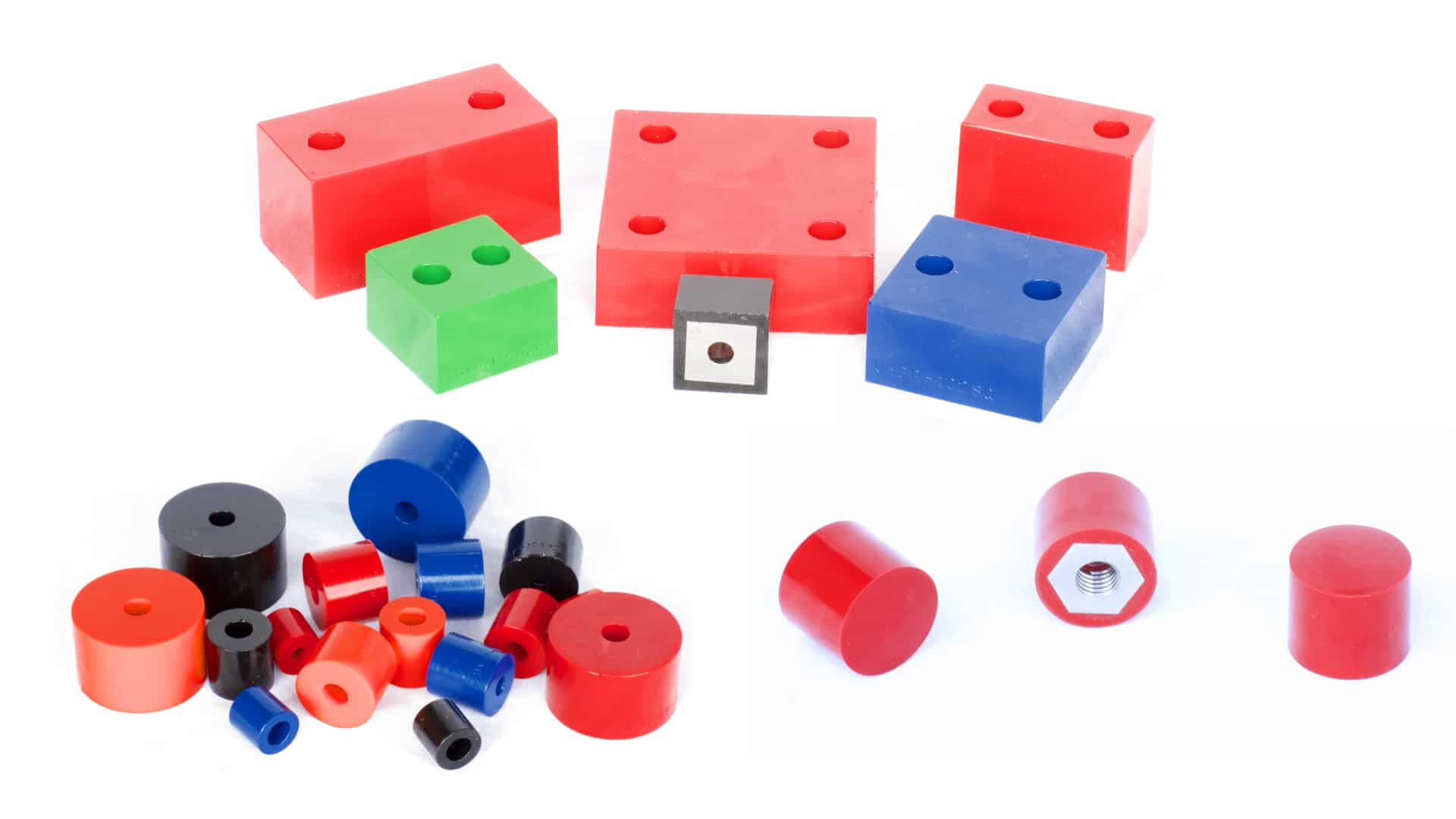
Specifically designed with common bolt patterns and sizes. All of our rectangular bumpers are compatible with ¼” socket head cap screws.
Square Bumpers

All of our square bumpers have evenly spaced bolt patterns and are designed for use with ¼” socket head cap screws.
Round Washer-Reinforced Bumpers
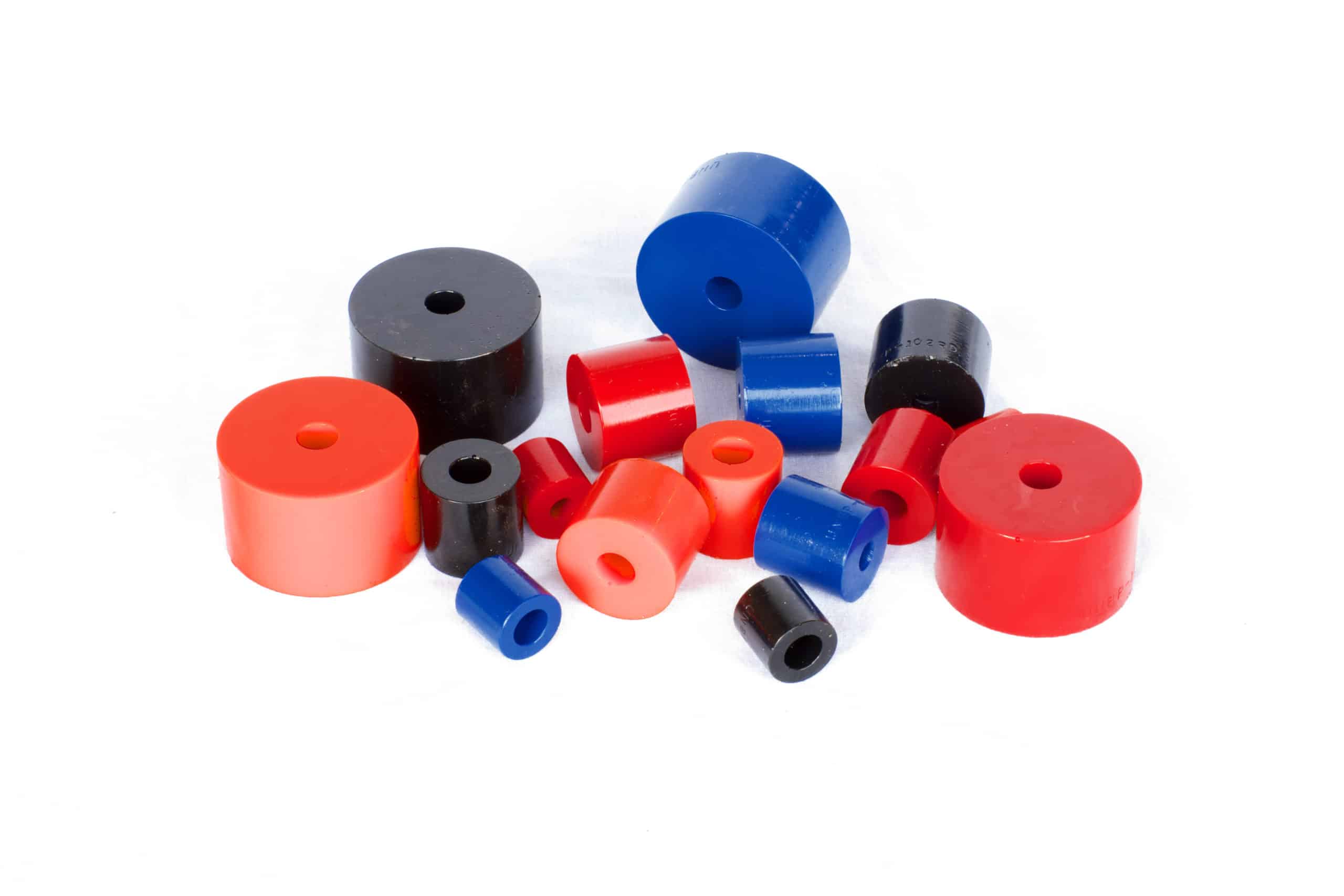
Round urethane bumpers reinforced with a steel washer to eliminate pull through. Designed to be used with various cap screws as noted in the table below.
Female Thread Round Bumpers
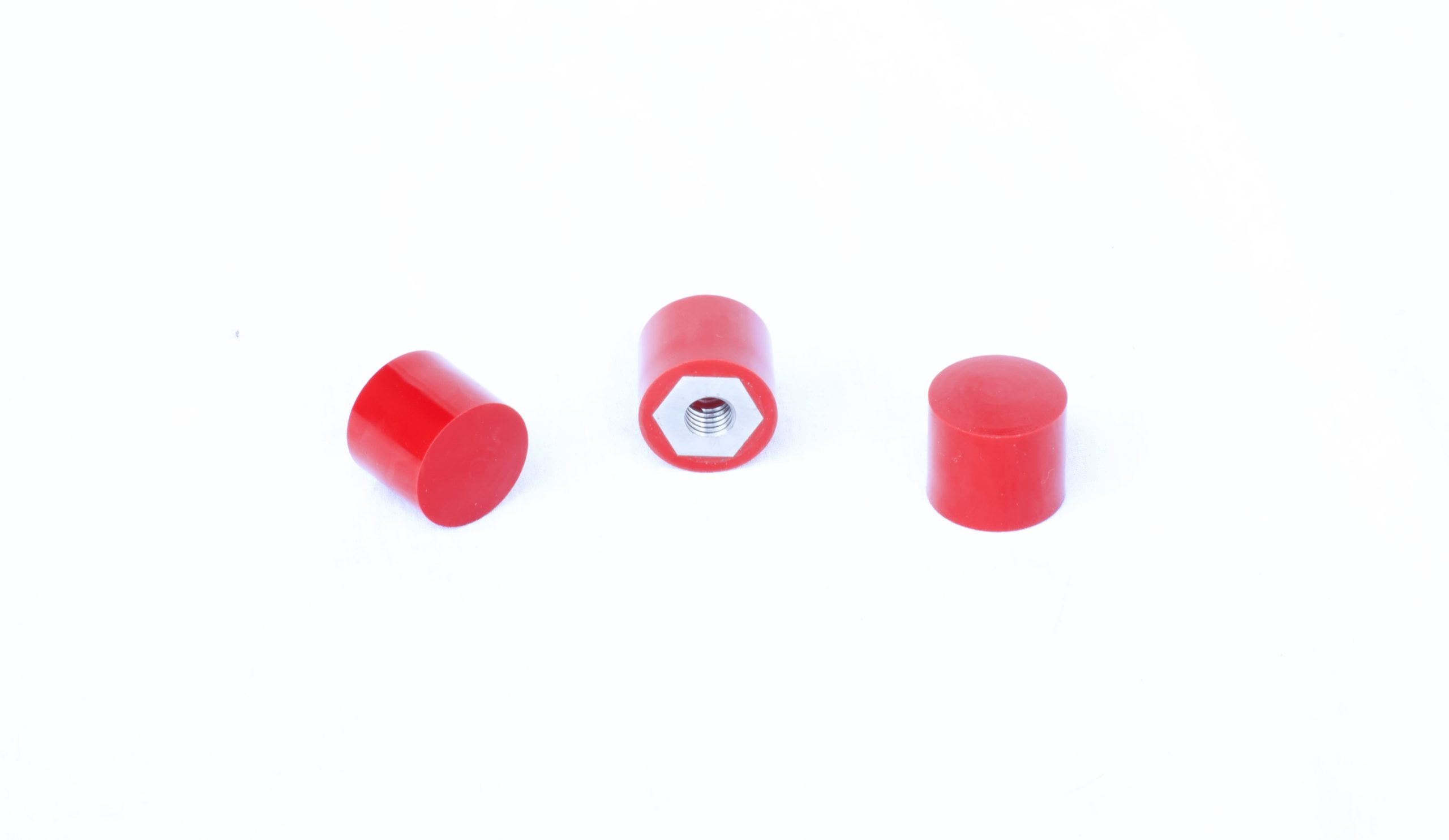
Our female thread bumpers have a molded-in steel hex insert that comes in various thread styles as noted in the table below. This insert is undercut to ensure strong bonding. Capable of handling repeated high impact.
How Do Polyurethane Bumpers Deliver the Same Reliability at Lower Cost?
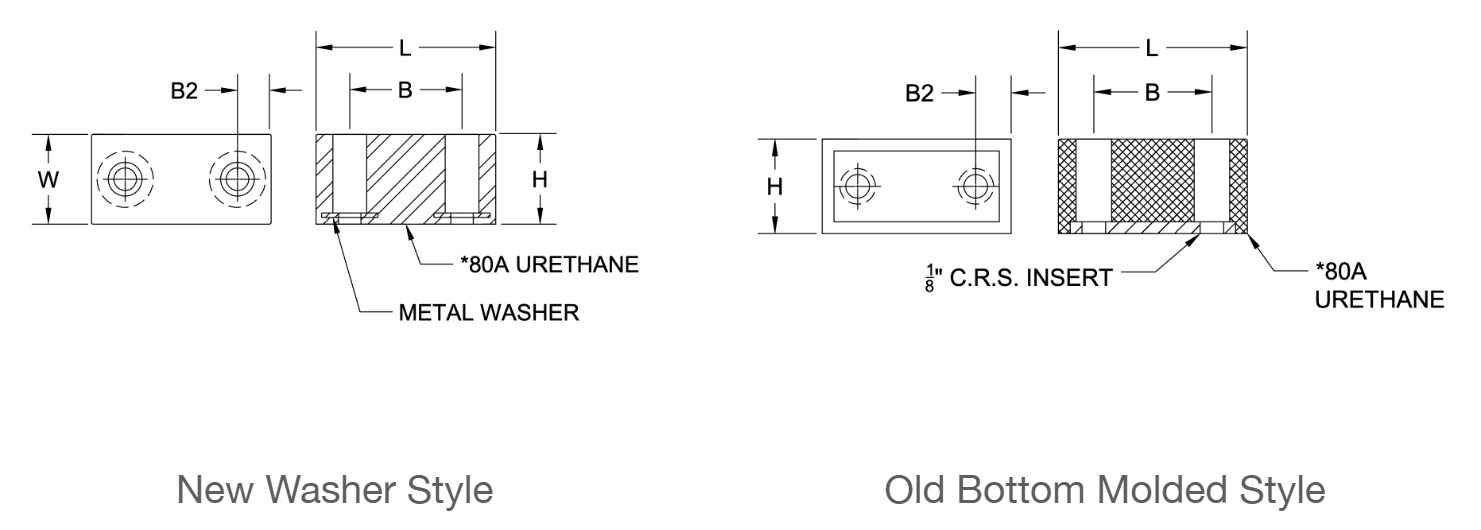
What sets our polyurethane bumpers apart from others is high quality with significant cost savings. Most other manufacturers use large, bottom-molded inserts; however, our polyurethane bump stops utilize molded-in washers. This contributes to significant cost savings of 20% or more and prevents bolt pull-through without tacking on unneeded costs. We have found that the older bottom molded insert style is overkill for most applications and have passed savings on to many customers by offering our molded-in washer style. Furthermore, this style of bumper allows the metal insert to be completely encapsulated by urethane. This ensures a better bond and prevents the metal insert from ever falling out. Please reference the style comparison example below:
Why Polyurethane Outperforms Rubber and Metal Bumpers
Polyurethane combines the resilience of rubber with the load-bearing strength of plastic, making it the superior choice when conventional materials fail. Here is how urethane bumpers compare:
- vs. rubber: Urethane delivers 2–4× longer service life, superior abrasion resistance, and better oil and solvent resistance. It holds tighter dimensional tolerances, reducing fit-up issues on precision equipment.
- vs. metal: Urethane eliminates metal-on-metal contact noise, prevents surface marring, and absorbs energy rather than transferring it, protecting both equipment and operators.
- vs. plastic: Unlike brittle plastics, cast urethane will not crack or shatter under repeated impact. It recovers its shape after deflection, delivering consistent long-term performance.
The result is lower maintenance costs, reduced downtime, and a measurable return on investment, even in the most aggressive production environments.
What Are the Properties and Performance Characteristics of Polyurethane Bumpers?
Every Uniflex urethane bumper is formulated to your exact application requirements. Key performance attributes include:
- Shock and impact absorption: Cast urethane disperses energy outward from the point of impact, protecting internal components and structural frames from repeated stress.
- Vibration dampening: Urethane prevents the transmission of noise and vibration between machine parts, producing quieter, safer operating environments.
- Abrasion resistance: High tear strength and a low coefficient of friction allow urethane bumpers to withstand sliding and impingement abrasion without sacrificing structural integrity.
- Chemical resistance: Resistant to oils, greases, hydraulic fluids, and many industrial solvents. Polyether-based formulations offer enhanced hydrolysis resistance for wet or washdown environments.
- Temperature performance: Functional across a broad operating temperature range, maintaining elasticity and resilience in both cold storage and elevated-heat applications.
- Bonding to metal: Urethane can be chemically bonded to steel, aluminum, or other metal inserts — enabling threaded studs, through-bolt mounting, and complex assemblies in a single part.
How Do You Choose the Right Durometer Hardness for Urethane Bumpers?
Durometer, measured on the Shore A or Shore D scale, determines how a urethane bumper responds to load. Uniflex can cast bumpers across the full hardness spectrum:
- 40–50 Shore A: Soft and highly flexible. Ideal for gentle impact cushioning, noise isolation, and applications where the mating surface must be protected from marking.
- 60–70 Shore A: General-purpose range. Most commonly specified for conveyor systems, automotive jigs, and robotic end-of-travel stops.
- 80–95 Shore A: Firm and highly abrasion-resistant. Suited for heavy-duty stamping die buffers, hydraulic cylinder cushions, and high-cycle machinery.
- Shore D (55+): Near-rigid urethane for structural applications requiring maximum load capacity and minimal deflection.
Not sure which durometer is right for your application? Our engineers will review your load requirements, cycle rate, and operating environment and recommend the optimal compound.
Which Industries and Applications Use Uniflex Urethane Bumpers?
Uniflex urethane bumpers serve a broad range of industries where impact protection, noise reduction, and component longevity are critical:
- Automotive manufacturing: End-of-travel stops, jig and fixture bumpers, conveyor lane guides, and body-shop impact pads.
- Robotics and automation: Robot arm limit stops, end-effector cushions, and automated guided vehicle (AGV) bumper systems.
- Material handling: Conveyor belt impact beds, dock bumpers, load stop pads, and pallet rack guards.
- Stamping and metal forming: Die-set buffers, hydraulic press cushions, and draw-ring supports.
- Mining and aggregate: Vibrating screen side liners, impact chute liners, and crusher feed lip protectors.
- Oil, gas, and heavy equipment: Shock isolators, cylinder cushions, and structural protection bumpers.
- Aerospace and defense: Precision alignment bumpers, vibration isolators, and MIL-spec shock pads.
- Agricultural equipment: Field-service-grade bumpers engineered for UV, mud, and wide temperature swings.
Ready to Upgrade Your Impact Protection with Custom Urethane Solutions?
Uniflex has been manufacturing custom cast urethane products since 1979. Our in-house design, machining, and casting capabilities mean your project moves from concept to production faster, and with tighter tolerances than most competitors can match. Whether you need 10 prototype bumpers or 100,000 production pieces, we build to your spec at competitive pricing.
Contact us at 248-486-6000, email sales@uniflexinc.com, or use our online quote form to get started.
Frequently Asked Questions
What is a urethane bumper?
A urethane bumper is a cast polyurethane component designed to absorb shock, limit travel, reduce noise, and protect equipment surfaces at points of repeated impact. Unlike rubber bumpers, urethane bumpers can be molded to precise tolerances, bonded to metal inserts, and formulated across a wide range of hardness values for application-specific performance.
How long do polyurethane bumpers last compared to rubber?
In most industrial applications, cast polyurethane bumpers outlast rubber bumpers by a factor of two to four. Urethane’s superior abrasion resistance, tear strength, and resistance to oils and solvents contribute to a significantly longer service life, particularly in high-cycle applications.
What durometer should I specify for my bumper?
The optimal durometer depends on the impact force, cycle rate, deflection tolerance, and mating surface hardness of your application. As a general guide: 40–60 Shore A for soft cushioning and noise isolation; 60–80 Shore A for general-purpose industrial use; 80–95 Shore A for heavy-duty or high-load applications. Contact Uniflex engineers for a no-charge durometer recommendation.
Can urethane bumpers be bonded to metal?
Yes. Cast polyurethane bonds chemically to steel and aluminum substrates, enabling metal-insert molding for threaded studs, mounting plates, and structural reinforcement — all in a single molded part. Uniflex has extensive experience engineering bonded urethane-to-metal assemblies.
Do you offer stock urethane bumpers for fast delivery?
Yes. Uniflex maintains stock urethane bumper lines in common shapes and durometers available for immediate shipment. Custom bumpers can typically enter production within days from receipt of approved drawings or tooling. Browse our online shop or request a custom quote.
What information do I need to request a custom urethane bumper quote?
To generate an accurate quote, provide: part dimensions (or a drawing/sample), required hardness or durometer if known, estimated annual quantity, mounting method, and the operating environment (temperature range, chemical exposure, dynamic vs. static load). Uniflex engineers will help fill in any gaps.